You step outside after a heavy spring rain, expecting to enjoy your freshly landscaped yard, only to find your lawn transformed into a squishy, waterlogged mess. Your boots sink into the saturated ground, and you notice water pooling dangerously close to your foundation. Sound familiar? If you’re a homeowner in Fredericton or the surrounding Atlantic region, you’re no stranger to the challenges that heavy rainfall, spring snowmelt, and clay-heavy soil create for your property.
Water doesn’t just make your yard unpleasant, it threatens the very foundation of your home. Left unchecked, poor drainage leads to basement flooding, foundation cracks, landscape erosion, and costly structural repairs that can run into tens of thousands of dollars. The good news? A properly installed French drain system can transform your soggy, problematic yard into a dry, functional outdoor space that protects your property investment for decades to come.
In this comprehensive guide, you’ll discover everything you need to know about French drain installation. We’ll walk you through how these drainage systems work, why they’re essential for Fredericton properties facing our climate challenges, and what separates a weekend DIY project from a professional installation that lasts a lifetime. You’ll learn about material selection, installation methods, discharge options, and maintenance practices that keep your drainage system performing flawlessly year after year. By the end, you’ll understand exactly what it takes to protect your home from water damage and make an informed decision about your drainage needs.
A French drain, also known as a weeping tile or perimeter drain, is a subsurface drainage system designed to redirect excess groundwater and surface water away from your property. This elegant design addresses one of the most common property challenges: managing unwanted water accumulation.
The system operates on a simple principle: water always follows the path of least resistance. A French drain creates an underground “highway” that captures water before it causes problems and channels it safely away from vulnerable areas.
The anatomy of a French drain consists of three essential components:
Sloped trench – A carefully excavated channel that provides the pathway for water movement
Perforated drainage pipe – The main conduit for water flow
Aggregate material – Gravel or rock that surrounds the pipe, creating void space for water collection while filtering out soil particles
When water saturates the soil around your property, it filters down through the aggregate material surrounding the perforated pipe. The pipe’s holes allow water to enter from all directions, and gravity pulls that water along the pipe’s downward slope toward a designated discharge point—whether that’s a municipal ditch, dry well, or natural drainage area.
French drains excel at several critical applications. They’re particularly effective for foundation protection, intercepting water before it seeps into your basement or creates hydrostatic pressure against foundation walls. They transform waterlogged gardens and soggy lawns into firm, usable ground by lowering the water table in problem areas.
French drains also play a vital role in erosion control. By intercepting and redirecting water flow, they reduce runoff that would otherwise wash away topsoil and damage your landscape. They help maintain optimal soil moisture levels, keeping your grass lush and plants thriving. When properly installed around your foundation, they relieve the hydrostatic pressure that causes foundation cracks and structural damage over time.
Fredericton’s climate presents specific challenges that make effective drainage systems essential for property protection. Heavy seasonal rainfall, spring snowmelt, and problematic soil composition create persistent water management issues for Atlantic homeowners.
The clay-heavy soil throughout Fredericton is particularly problematic. Unlike sandy soils that drain naturally, clay is dense and impermeable. Water saturates clay with nowhere to go, creating persistent puddles and soggy areas. Clay expands when wet and contracts when dry, stressing foundation walls and hardscape features.
New Brunswick’s freeze-thaw cycles add complexity. When trapped water freezes, it expands, pushing against foundations and creating cracks. This cycle repeats throughout winter and spring, gradually causing worsening structural damage. Water seeping into foundation cracks and freezing can widen them significantly.
The consequences of poor drainage extend beyond inconvenient puddles:
Foundation damage – Pooling water finds cracks in concrete, causing basement flooding, mould, and structural instability
Landscape erosion – Rainfall washes away topsoil, creates gullies, and undermines retaining walls and hardscape
Pest breeding grounds – Standing water attracts mosquitoes and other pests
Property value reduction – Drainage issues make buyers wary of future costs
Foundation repair typically costs $10,000 to $50,000 or more, making drainage problems expensive to ignore. Soil loss undermines healthy plant growth, and landscapes gradually deteriorate.
The cost difference between preventative drainage installation and foundation repair is dramatic. Investing in a French drain system protects against exponentially more expensive problems. Poor drainage diminishes enjoyment of your outdoor space and limits property use.
The longevity and effectiveness of your French drain system depend almost entirely on the materials you choose. In Fredericton’s challenging climate, where freeze-thaw cycles and heavy moisture are constants, material quality isn’t just about performance, it’s about whether your system lasts five years or fifty years. Understanding the differences between available options helps you make informed decisions that match your budget with your long-term needs.
Your French drain’s perforated pipe comes in several varieties with distinct performance characteristics and lifespans.
Corrugated “Big-O” pipe is the most budget-friendly option with small slit inlets. While attractive for DIY projects, this thin-walled pipe crushes easily under soil weight, especially in clay. Without proper fabric protection, these slits clog rapidly. Most corrugated pipe installations fail within two to twenty-four months without professional installation.
PVC perforated pipe offers better durability with rigid construction that resists crushing. However, PVC becomes brittle in extreme cold and cracks during freeze-thaw cycles if not installed below the frost line. Standard PVC perforations appear only at the five and seven o’clock positions, requiring a gravel bed. This configuration can cause standing water and increased root infiltration risk.
High-performance perforated pipe (such as Baughman Tile) represents the professional-grade option. This pipe features 360-degree perforation with large inlet holes providing superior water intake from all directions. The design facilitates water collection and air exchange, which dries subsoil faster and prevents anaerobic conditions that encourage root growth. The construction withstands soil pressure and freeze-thaw cycles without degrading. These systems last fifty years or more—essentially a permanent installation.
At Atlantic Hardscape and Concrete, we recommend high-performance pipe for Fredericton installations because our climate demands materials that handle extreme conditions. The relationship between pipe quality and system longevity is direct: invest in superior materials now, and you won’t be excavating and reinstalling in a few years.
The aggregate material surrounding your drainage pipe is as critical as the pipe itself. It creates void space for water collection and filters out soil particles that would clog the system.
Native clay soil should never be used as backfill. Clay is impermeable—water cannot move through it. Using excavated clay defeats the entire purpose of the drainage system, creating a sealed channel where water cannot enter the pipe. This is one of the most common DIY mistakes.
Clear gravel (3/4-inch) provides reasonable void space and is widely available at moderate prices. However, smaller gravel can shift and compact over time, reducing void space and limiting capacity during heavy flow.
Round rock (1 1/2-inch) is the superior choice for high-performance systems. The larger size and rounded shape create maximum void space—gaps where water collects and air circulates. This provides several advantages:
Creates an underground reservoir effect during heavy storms
Handles high-volume water events without backing up
Facilitates air circulation for faster subsoil drying
Resists compaction, maintaining performance for decades
Atlantic Hardscape and Concrete specifies 1 1/2-inch round rock in our professional installations for the long-term performance our clients expect. While slightly more expensive than smaller gravel, the performance benefits and extended lifespan make it the clear choice for permanent lawn drainage systems.
Landscape fabric is the critical filter maintaining your French drain’s functionality. However, selecting the wrong type causes premature system failure.
Standard “weed barrier” fabric from home improvement stores is unsuitable for French drains. Designed to suppress plant growth rather than manage water flow, its tight weave restricts water movement and clogs rapidly from silt and fine particles.
Professional-grade double-punched non-woven geotextile fabric is purpose-engineered for drainage systems. The “double-punched” process creates exceptional water flow characteristics—permitting over 100 gallons per minute per square foot while filtering soil particles. Non-woven construction delivers superior filtration and resists clogging.
This fabric prevents silt infiltration while preserving water flow—essential for sustained performance. It encases aggregate material, creating a protective barrier preventing clay soil and silt from contaminating drainage rock, preventing gradual clogging over decades.
Fabric quality directly determines maintenance requirements. Premium geotextile fabric ensures your French drain flows freely for fifty years or longer. Inferior or absent fabric guarantees clogs, diminished flow, and potentially complete system replacement within years.
Careful planning, proper technique, and attention to detail are essential for french drain installation. The “burrito-wrap” method used by professionals represents the gold standard, creating a completely encapsulated system that resists clogging and maintains lifetime performance.
Before any excavation begins, contact utility locating services—in Canada, services like “Click Before You Dig” mark underground power lines, water mains, gas lines, and telecommunications cables. Many professional contractors also hire private locating companies for lines public services might miss. Hitting buried utilities creates serious safety hazards and expensive repairs.
Walk your property after heavy rain and mark where water ponds or flows with landscape flags. This visualizes the path your French drain should follow, from problem areas to a suitable discharge point, following natural downhill slopes to minimize excavation depth.
Legal requirements vary by municipality. Fredericton building codes may have specific discharge requirements. Some municipalities forbid discharging into sanitary sewers, as this overloads treatment facilities during heavy rain. Verify local requirements before finalizing your plan.
Trench excavation follows precise specifications. Standard residential trenches measure approximately sixteen inches wide and eighteen to twenty-four inches deep, though foundation protection may require six feet or more. The critical factor is maintaining consistent downward slope—minimum one-eighth inch per foot (approximately 1% grade) ensures water flows steadily toward discharge rather than pooling.
The burrito-wrap method begins once your trench reaches proper depth and slope:
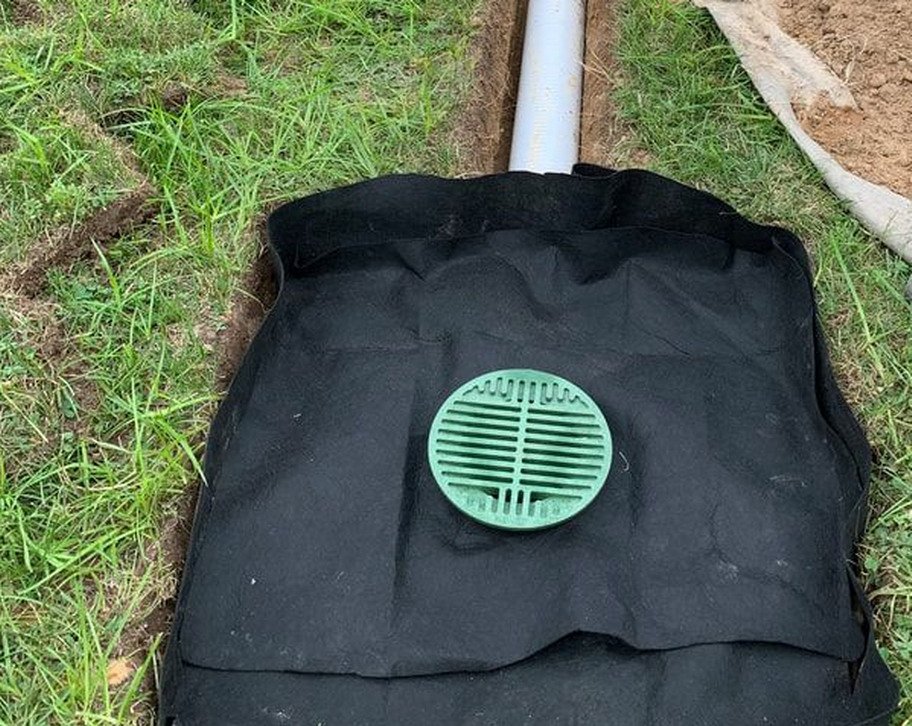
Line the trench with double-punched geotextile fabric, leaving excess on both sides
Place perforated pipe directly on the fabric-lined bottom
Fill with 1 1/2-inch round rock, covering the pipe completely
Fold excess fabric over the top, completely encapsulating rock and pipe
Add sandy topsoil over the wrapped fabric
Restore sod or plant grass seed
This “burrito” configuration prevents soil from migrating into your drainage system, preventing the gradual clogging that causes system failure.
Catch basin installation provides additional protection in areas with heavy surface debris. A catch basin is a collection box with a grated top that allows water entry while filtering leaves, twigs, and debris. This prevents organic material from entering your pipe system where it could decompose and create clogs. Catch basins are valuable near trees or where runoff carries significant debris.
Quality control throughout installation ensures optimal performance. Verify slope at multiple points using a level sections sloping backward create standing water and reduce effectiveness. Before final backfilling, test water flow by running a hose into the system and observing how quickly water exits at the discharge point. This simple test identifies problems while they’re still easy to correct.
A French drain is only effective with proper discharge. Even a perfectly installed system will fail if water has nowhere to go. Choosing the right discharge option is critical for long-term performance.
Curbside or municipal ditch discharge is most common in urban settings. This directs drainage to the street curb or roadside ditch where it enters the municipal storm system. Verify your municipality allows this, some areas restrict residential discharge when systems are overtaxed during heavy rain.
Property daylighting works when your lot has natural slope and space. The pipe exits above ground at your property edge, allowing water to flow naturally downward. Position the discharge point to avoid erosion and neighbouring properties. Use a splash block or rock apron to dissipate water energy.
Dry well systems suit rural properties or when other options aren’t feasible. A dry well is a large underground pit—typically three feet deep and four feet wide—filled with gravel. Water gradually dissipates into the subsoil. These work best in areas with permeable subsoil and adequate space from structures.
Sump pump systems are necessary when topography prevents gravity-fed discharge. If terrain is flat or the discharge point is higher than your drain, a sump pump is required. Water collects in a concrete basin, and an electric pump activates to lift water to a suitable discharge point. These require regular maintenance and have electrical costs, but may be your only option.
Discharge point requirements include:
Minimum ten feet from your foundation
Avoid discharging onto neighbouring properties
Position at lower elevation than your drain
Locate where water won’t cause erosion
Discharge planning is as critical as installation because the system depends on a viable exit point. A drain terminating in a low spot or too close to a foundation defeats its purpose. Atlantic Hardscape and Concrete’s evaluation process carefully considers discharge options, ensuring your system has an effective, compliant arrangement for permanent water removal.
Choosing between DIY and professional French drain installation means weighing performance, longevity, and value for your property.
The basic DIY approach uses hand-dug trenches, corrugated pipe, and native soil. Materials cost $500 to $1,500. These systems typically fail within two to twenty-four months as clay soil compacts around the pipe, crushing and clogging it.
Intermediate DIY installations use machine excavation, PVC pipe, clear gravel, and landscape fabric. Costs range from $2,000 to $4,000. With proper technique, these systems last ten to twenty years—ideal for experienced homeowners with straightforward drainage challenges.
Professional high-performance installation using the complete burrito-wrap system provides a permanent solution. Costs range from $5,000 to $17,000 or more. This delivers a system designed to last fifty to two hundred years. It uses high-capacity pipe with 360-degree perforation, 1 1/2-inch round rock, and complete encapsulation with double-punched geotextile fabric.
Cost differences reflect long-term value. A $1,000 DIY system failing in two years costs $500 annually. A $10,000 professional system lasting fifty years costs $200 annually—less than half. Factor in repeated installation labour and disruption, and professional systems become even more cost-effective.
Complexity factors should influence your decision:
Property size and drainage run length
Soil conditions (clay requires careful installation)
Proximity to utilities
Discharge challenges
Foundation protection requirements
DIY works for small, straightforward projects in accessible areas. With proper equipment and experience, DIY can serve you well, but recognize its limitations.
Professional expertise is essential for foundation protection, extensive networks, complex topography, difficult discharge, and permanent solutions. Atlantic Hardscape and Concrete begins with thorough site evaluation.
Professional installation benefits extend beyond drainage:
Prevents foundation damage (saves $10,000 to $50,000+ in repairs)
Protects landscape value
Eliminates recurring problems
Increases property value
Provides peace of mind
Even high-quality French drain systems need periodic maintenance for optimal performance. Properly installed systems require minimal intervention—especially those using the burrito-wrap method. Understanding basic maintenance helps protect your drainage investment and catch problems early.
Annual inspection should be part of your routine. Walk your property after heavy rain and verify proper drainage—no standing water should remain. Check inlet points for debris and inspect the discharge point. Look for erosion or settling along the drainage path.
Sump pump maintenance is critical for systems with mechanical pumping. Test your pump twice yearly—spring and fall. Pour water into the basin and verify proper activation. Check the float mechanism and electrical connections. Clear sediment from the basin and consider a battery backup system.
Lawn care affects drainage performance. Healthy grass with deep roots helps water reach your system. Compacted soil reduces infiltration. Aerate periodically to maintain soil porosity above your drainage system.
Periodic flushing clears accumulated sediment. If your system includes clean-out points, use a garden hose to flush the system. This removes settled particles and maintains flow capacity. Flushing every few years is typically sufficient.
Signs of system problems require prompt attention:
Standing water persisting more than twenty-four hours after rainfall
Soggy areas reappearing in previously dry locations
Slow drainage taking hours to dissipate
Foundation moisture or basement dampness
Properly installed burrito-wrap systems offer maintenance advantages. Because aggregate is encapsulated in fabric, soil cannot migrate and cause clogging. The large void space resists compaction and maintains flow capacity.
Call Atlantic Hardscape and Concrete for professional assessment when problems persist, when your system reaches twenty years, or when property changes affect drainage patterns. Adding hardscaping, changing grading, or building additions can alter water flow and potentially overwhelm your existing system.
Understanding common installation errors helps you avoid costly problems whether you’re planning a DIY project or evaluating contractor proposals. These mistakes represent the primary reasons French drain systems fail prematurely.
Insufficient slope is the most fundamental error. Systems without proper 1% grade fail to move water effectively, causing pooling and attracting roots. Always verify slope with a level at multiple points, ensuring consistent grade throughout the entire run rather than steep sections mixed with flat or backward slopes.
Wrong pipe placement creates hidden performance problems. PVC pipes with bottom perforations must sit on gravel beds to function. Placing them directly on fabric-lined soil prevents water from entering bottom perforations, creating standing water that attracts tree roots.
Inadequate fabric protection leads to rapid failure. Standard landscape fabric clogs quickly and lacks proper water flow capacity. Omitting fabric allows clay soil to fill void spaces in drainage rock, creating an impermeable mass. Always use double-punched non-woven geotextile fabric rated for drainage applications.
Poor discharge planning defeats even well-installed systems. Ending drains in low spots causes water backup. Discharging within ten feet of foundations means water flows back toward your home. Discharging onto neighbouring properties creates legal issues.
Mixing soil with aggregate eliminates the void space that makes French drains work. Clay soil particles migrate into spaces between rocks, eventually creating a compacted mass that blocks water movement. This is why the burrito-wrap method—completely encapsulating aggregate in fabric—is so effective.
Ignoring frost line depth in New Brunswick creates vulnerability to freeze damage. Shallow installations experience winter freezing that cracks pipes and creates ice blockages during spring thaw. Residential installations should reach eighteen to twenty-four inches deep, while foundation protection systems often extend six feet or more.
Skipping utility locating creates serious safety hazards and expensive repairs. Hitting power lines can be fatal. Severing gas lines creates explosion risks. Cutting fibre optic cables can result in repair bills exceeding $10,000. Always contact utility locating services before excavation.
Atlantic Hardscape and Concrete’s fifteen-plus years of experience in Fredericton means we’ve seen every drainage challenge and know how to avoid these pitfalls. Our installation process includes thorough site evaluation, precise slope verification, proper material selection for local climate, and quality control at every stage.
Professional site evaluation extends beyond avoiding mistakes. Experienced contractors identify underlying issues like high water tables, underground springs, or soil composition variations, designing solutions that address these challenges and spot potential problems before they occur.
Protecting your Fredericton property from water damage safeguards your foundation, preserves your landscape investment, and maintains long-term value. A properly installed French drain transforms waterlogged areas into dry, functional spaces that enhance your property’s beauty and usability.
The relationship between material quality, installation method, and system longevity is undeniable. Basic installations using inferior materials might save money initially but fail within months, requiring repeated replacement. Professional installations using premium materials and the burrito-wrap method deliver permanent solutions that protect your property for fifty years or more.
French drains represent one of the most cost-effective ways to prevent expensive foundation repairs, eliminate basement flooding, control erosion, and create well-drained landscapes. When foundation repairs cost $10,000 to $50,000 or more, investing in quality drainage makes financial and practical sense.
Atlantic Hardscape and Concrete uses only premium materials—high-capacity perforated pipe, 1 1/2-inch round rock, and double-punched geotextile fabric—installed with precision techniques. Our fifteen-plus years of experience in Fredericton and the Atlantic region means we understand local climate challenges and design drainage systems that handle heavy rainfall, spring snowmelt, and freeze-thaw cycles year after year.
For complex drainage challenges or situations requiring permanent protection, professional installation provides expertise, equipment, and quality control that DIY approaches cannot match. We encourage property owners to prioritize professional installation when protecting their most valuable asset.
Contact us today for a customized drainage evaluation. We’ll assess your property’s challenges, design a tailored solution, and provide expert installation that transforms your soggy yard into the beautiful, well-drained outdoor space you deserve. Let us help you protect your property with drainage built to last a lifetime.
French drain lifespan varies dramatically based on materials and installation quality. Basic DIY installations using corrugated pipe and minimal fabric protection typically fail within two to twenty-four months. Intermediate installations with PVC pipe and proper gravel backfill last ten to twenty years with proper maintenance. Professional installations using high-performance pipe, 1 1/2-inch round rock, and complete burrito-wrap encapsulation are designed to last fifty to two hundred years. At Atlantic Hardscape and Concrete, we install systems built for permanent performance essentially a once-in-a-lifetime installation that protects your property for generations.
Properly installed French drain systems require minimal maintenance. Annual inspections after heavy rains verify proper drainage and check for standing water. Catch basin grates should be cleared of leaves and debris seasonally. Sump pumps (if present) need testing twice yearly and occasional cleaning. Lawn aeration helps maintain water infiltration to the drainage system. Periodic flushing through clean-out points (every few years) removes accumulated sediment. Systems installed with the burrito-wrap method and premium materials need very little intervention—the complete fabric encapsulation prevents soil infiltration and clogging. Atlantic Hardscape and Concrete’s installations are designed for decades of maintenance-free performance.
French drain discharge location is critical for system effectiveness and must comply with local regulations. Common options include municipal ditches or storm sewers (where permitted by local bylaws), property daylighting to lower areas at your property edge, dry wells for rural properties with permeable subsoil, and sump pump systems for flat terrain where gravity discharge isn’t possible. The discharge point must be at least ten feet from your foundation, positioned lower than your drainage system for consistent flow, and located where exiting water won’t cause erosion or flow onto neighbouring properties. Atlantic Hardscape and Concrete evaluates discharge options during site assessment to identify the best arrangement for your specific property and ensure compliance with Fredericton regulations.
GET STARTED
Your dream space is within reach as we work together from detailed 3-D designs to the final custom build. Our process is both professional and exciting, and we look forward to taking this journey with you.
Contact
34 Jackstraw Court, Fredericton, NB, Canada, New Brunswick
