You have spent an evening comparing finish samples, brushed versus exposed aggregate, standard grey versus charcoal , for the new front walkway you’re planning. The design is sorted, the colours decided. Then your contractor asks how deep you want the pour, and you realize you haven’t thought about it once.
That gap matters more than most homeowners expect. Concrete walkway depth is one of the most structurally important decisions in any residential concrete walkway project, yet it rarely gets the attention it deserves. Pour it too thin and you’re looking at cracking, frost heave, and costly repairs within a few years. Get the depth , and everything below it , right, and a well-built walkway can hold up for decades.
For homeowners in Fredericton and across New Brunswick, this decision carries extra weight. Frost can push four to five feet into the ground during a hard winter, and the region sees repeated freeze-thaw cycles from late fall through early spring. How thick should a concrete walkway be doesn’t have one universal answer , it depends on how the walkway will be used and what it’s sitting on.
This article covers the standard depth for residential walkways, how Fredericton’s climate shapes those specifications, why the gravel base deserves as much attention as the slab, and the reinforcement choices and installation mistakes worth knowing before you sign any contract. Atlantic Hardscape and Concrete has 15 years of local experience building walkways in this climate, and that knowledge informs everything that follows.
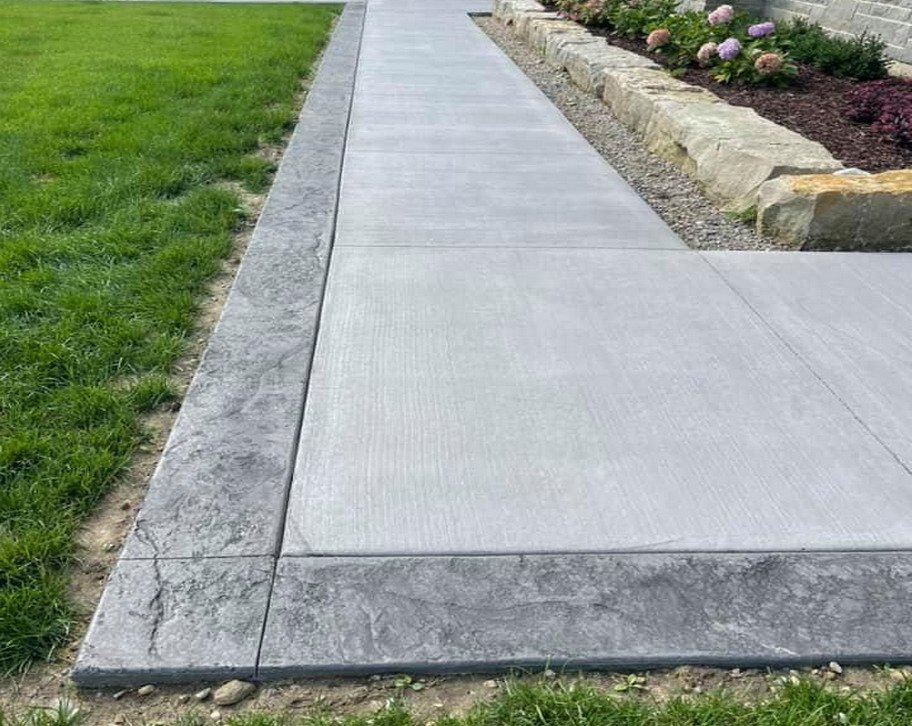
The industry standard for concrete sidewalk thickness on a residential property is 4 inches (approximately 100 mm). This is the established minimum that concrete contractors across Canada work from for pedestrian-only applications , backed by real-world performance over decades of Canadian winters. At 4 inches, a properly mixed slab carries enough mass to resist cracking under foot traffic, stay level over time, and hold up against frost heave when set on a well-prepared base.
This standard concrete sidewalk depth applies across the most common walkway types around a home:
Front entry paths and main entrance approaches
Side-yard and backyard garden paths
Decorative or stamped concrete walkways (the decorative finish adds no structural value, so the same depth rules apply)
Pathways connecting a driveway to a garage door, side entry, or outbuilding
Some sources suggest 3.5 inches as acceptable in milder climates, but in Canada , and particularly in New Brunswick , 4 inches is the absolute minimum, not a midpoint to aim just above. Treating it as a ceiling rather than a floor is one of the planning errors most often linked to premature walkway failure.
When the walkway needs to carry more than typical foot traffic, the minimum concrete thickness increases. Here’s a practical reference:
Use case | Recommended depth |
|---|---|
Pedestrian foot traffic only | 4 inches (100 mm) |
Occasional light vehicles (lawn tractor, motorcycle) | 5 to 6 inches (125–150 mm) |
Walkway doubling as parking apron or driveway-adjacent | 6 inches (150 mm) minimum |
Regular vehicle access | 6 to 8 inches |
A poured concrete walkway beside a driveway that occasionally takes vehicle weight needs a different specification than a quiet backyard garden path. The load the surface will actually carry is always the starting point for the depth decision.
Fredericton’s winters are demanding on any concrete structure. Frost can penetrate the ground to depths of 4 to 5 feet (1.2 to 1.5 metres) in a severe season, and the city regularly cycles through freeze-thaw events from late fall through early spring. Each time the ground freezes, it expands; each time it thaws, it contracts. That repeated movement places intense pressure on any slab sitting on unstable or poorly drained soil , producing heaving, cracking, and shifting that compounds with each passing year.
Pouring thicker concrete helps, but depth alone can’t carry the full load. A 4-inch slab on a well-drained, compacted granular base will consistently outlast a 6-inch slab poured directly onto native clay or organic soil. Concrete path thickness and base preparation are part of the same equation , one cannot compensate for failures in the other.
The concrete mix design matters just as much for any concrete thickness for foot traffic decision in this region:
Air-entrained concrete is a standard specification for Canadian exterior flatwork, not an optional upgrade. Microscopic air bubbles built into the mix create expansion space for water as it freezes inside the slab, dramatically reducing the surface scaling and spalling that appears after repeated freeze-thaw cycles. For a walkway in Fredericton’s climate, it’s a non-negotiable part of the mix.
For residential walkways, the baseline compressive strength is 3,000 psi (20 MPa), but 3,500 to 4,000 psi is the stronger choice for exterior applications in Fredericton. The additional strength provides better resistance to frost-induced pressure and greater durability against de-icing chemicals that are a routine presence through a New Brunswick winter.
De-icing products penetrate surface pores and break down the cement paste with each thaw cycle. Lower-strength or non-air-entrained concrete deteriorates noticeably faster when exposed to these products , making mix strength a practical concern, not just a specification on paper.
Proper drainage completes the picture. Walkways should pitch away from your home at approximately 1/8 inch per foot to prevent surface water from pooling and working into any developing cracks. At Atlantic Hardscape and Concrete, slope and drainage integration are standard parts of every poured concrete walkway installation completed in Fredericton , because in this climate, they’re structural decisions.
Most homeowners, when asked how deep their walkway is, describe the concrete layer. That’s the visible part, so it makes sense. But the compacted granular sub-base sitting beneath the slab is equally responsible for long-term durability , and skimping on it causes early failure even when the concrete slab thickness for walkway is specified correctly.
A properly built sub-base does three things the concrete can’t do on its own:
Drains water away from beneath the slab before it can freeze and push the concrete upward , the process known as frost heave
Distributes surface loads over a wider footprint, relieving the concentrated stress that starts cracks
Creates a stable, level platform that prevents uneven settling and the tripping hazards that follow
In Atlantic Canada, a complete residential concrete walkway installation typically runs 8 to 10 inches below finished grade: 4 to 6 inches of compacted granular gravel at the base, topped with 4 inches of concrete. Atlantic Hardscape and Concrete recommends a minimum 2 to 3 inches of compacted gravel as the stable foundation beneath walkway installations, with sub-base depth adjusted for site-specific soil conditions and drainage requirements. In areas with clay-heavy or poorly draining soils , which appear in parts of New Brunswick , deeper base preparation is typically appropriate.
Understanding how deep to pour a concrete walkway means accounting for the complete depth from finished surface down to undisturbed subgrade , not just the concrete layer at the top. Before accepting any contractor proposal, confirm both the concrete slab thickness and the sub-base depth and material type in the quote. A contractor confident in their work will specify both without hesitation.
Concrete handles compression , the downward force of foot traffic , very well. What it handles less naturally is tension, the stretching force that builds when the ground shifts, temperatures swing, or loading is uneven across the slab. Concrete walkway reinforcement manages those tensile forces so the slab stays together under stress rather than pulling into separate sections.
For standard 4-inch residential walkways, 6×6 welded wire mesh is the most common and cost-effective choice. It needs to sit at mid-depth , approximately 2 inches from the bottom , elevated on wire chairs or supports. Mesh resting on the gravel base does nothing structurally; it only functions when embedded within the concrete at the correct height.
For heavier applications , commercial paths, vehicle-crossing surfaces, or any slab over 5 inches thick , #3 or #4 rebar in a grid pattern is the preferred option, requiring 1.5 to 2 inches of concrete cover from the slab’s bottom. Fibre-reinforced concrete, which incorporates synthetic or steel fibres directly into the mix, is increasingly popular for Canadian exterior flatwork as a supplement that improves crack resistance throughout the full slab depth.
For anyone planning a DIY concrete walkway or reviewing a contractor proposal, these are the mistakes most likely to cause early failure:
Pouring at 2 to 3 inches is the most consequential error. The slab lacks the mass to resist frost heave or point loading, and it typically starts cracking and chipping at the edges within the first few freeze-thaw seasons , often reaching a point where full replacement is cheaper than patching.
Inconsistent depth from uneven subgrade preparation creates abrupt transitions in slab thickness. Stress concentrates at those transition points, and cracking follows along lines that trace directly back to the thin sections beneath.
Mesh or rebar left on the subbase rather than raised to mid-depth using chairs or supports provides zero tensile benefit. It only does its job when it’s actually inside the concrete at the right elevation.
A below-spec mix , under 3,000 psi or diluted with excess water added on-site for easier workability , produces a porous, weakened slab that will surface-deteriorate regardless of how carefully the depth was measured.
These errors carry real concrete walkway cost consequences. At Atlantic Hardscape and Concrete, mix specifications, reinforcement placement, and confirmed slab depth are addressed at the planning stage on every project , so the walkway performs as it should from day one.
Getting concrete walkway depth right is the foundation of a walkway that holds up for decades rather than a few seasons. For residential homes, the proven standard is 4 inches of concrete on a well-prepared, compacted granular base , and in Fredericton’s climate, that combination isn’t optional. Paired with air-entrained concrete at 3,500 to 4,000 psi, properly positioned reinforcement, and a correct drainage slope, a well-built walkway can deliver 30 to 50 years of reliable service. Skip any part of that system, and repairs arrive far sooner.
Atlantic Hardscape and Concrete brings 15 years of Fredericton-specific experience to every walkway project , from initial 3D design through to precise installation, with close attention to every specification that determines long-term performance.
Ready to plan your next walkway? Contact Atlantic Hardscape and Concrete to book a consultation or request a custom 3D walkway design for your property.
Yes , a compacted granular sub-base is essential, particularly in freeze-thaw climates like New Brunswick. The gravel layer channels water away from beneath the slab before it can freeze and cause frost heave, while also providing the stable, level platform that prevents uneven settling. Skipping the sub-base is one of the leading causes of premature cracking in otherwise correctly poured concrete walkways.
A simple DIY concrete walkway is technically possible for smaller, straightforward projects. However, incorrect mix ratios, insufficient base preparation, inconsistent slab depth, and misplaced reinforcement are all common mistakes that lead to early failure , especially in Fredericton’s demanding climate. For a walkway expected to perform reliably over the long term, professional installation is the recommended approach.
GET STARTED
Your dream space is within reach as we work together from detailed 3-D designs to the final custom build. Our process is both professional and exciting, and we look forward to taking this journey with you.
Contact
34 Jackstraw Court, Fredericton, NB, Canada, New Brunswick
