Have you ever installed outdoor lighting only to find your yard bathed in harsh, uncomfortable brightness instead of the warm glow you imagined? Does your pathway lighting feel more like an airport runway than an inviting garden walk? You’re not alone in this frustration.
The problem is that most most landscape lighting creates glare rather than ambiance because fixtures are chosen for brightness rather than effect. When light hits your eyes directly instead of illuminating the surfaces you want to showcase, visual discomfort replaces the welcoming atmosphere you envisioned for your Fredericton property.
Glare happens when light sources are too bright, poorly aimed, or positioned where they shine directly into your line of sight. The solution lies in understanding how fixture selection, placement strategy, and technical specifications work together to create layered lighting that highlights your landscape’s beauty without the blinding brightness. This article explains the root causes of landscape lighting glare and provides practical guidance on achieving the soft, dimensional ambiance that transforms outdoor spaces into evening retreats.
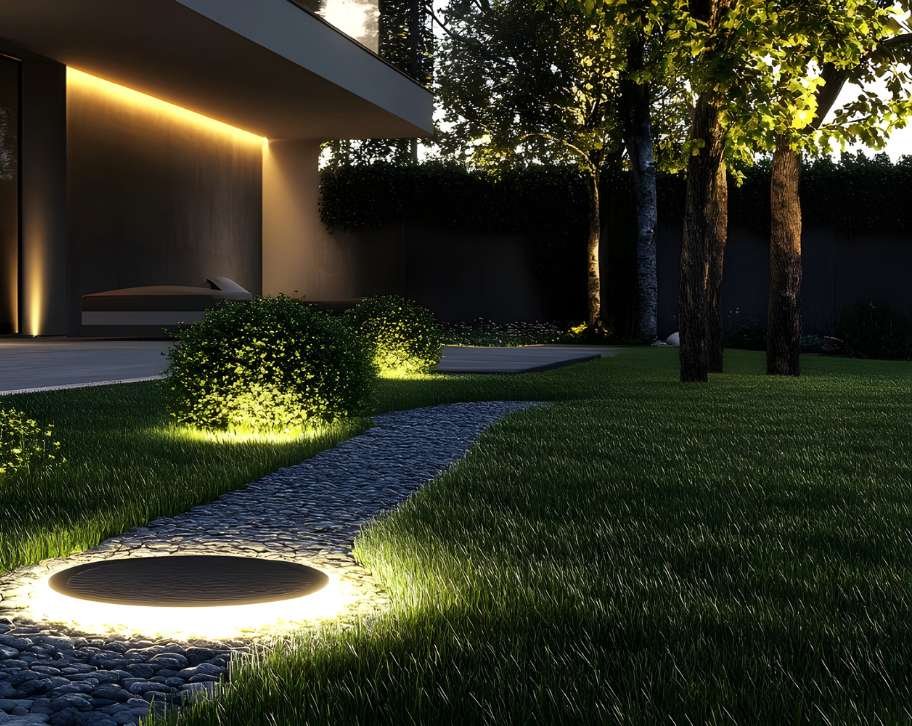
Glare occurs when light strikes your eyes directly rather than reflecting off the surfaces you want to illuminate. This direct exposure causes your pupils to constrict rapidly, making surrounding areas appear darker and creating visual discomfort that destroys any sense of ambiance.
The primary culprit is the “naked lamp” syndrome. When bulbs or LED chips are visible at eye level, the intense point of light overwhelms your vision. Professional Professional landscape design focuses on showing the effect of light (the texture of stone, the shape of foliage, the path ahead) rather than the source itself. Fixtures positioned too high, aimed incorrectly, or lacking proper shielding send light directly into common viewing angles instead of onto intended targets.
Excessive lumen output for the environment ranks as another major cause. Many property owners install high-powered fixtures thinking brightness equals security or beauty. A 500-lumen spotlight might seem appropriate in a showroom, but in a dark residential yard, it creates painful contrast between extreme brightness and deep shadow. This harsh division eliminates the subtle gradations that define true ambiance.
Poor spacing compounds the problem. When fixtures are placed too close together, their light zones overlap and create flat, washed-out brightness with no depth or shadow. This “landing strip” effect is common along pathways where lights are installed in perfectly symmetrical rows on both sides. The result is a distracting visual rhythm that draws attention to the fixtures themselves rather than guiding movement naturally through the space.
Reflective surfaces amplify glare significantly. Concrete driveways reflect approximately 40% of incident light, while water features can double perceived brightness. In Fredericton, wet pavement and snow create additional reflective challenges. When designers fail to account for these multipliers, a moderately bright fixture becomes a source of intense glare as light bounces back from these surfaces.
Single-method lighting approaches create flat illumination without dimension. Relying only on uplighting or only on downlighting produces areas of uncomfortable brightness surrounded by oddly dark zones. Without the interplay of light and shadow, the landscape loses depth and texture.
Factor | Glare-Producing Installation | Ambiance-Focused Design |
|---|---|---|
Fixture visibility | Bulbs visible at eye level from common viewing angles | Fixtures hidden in planting beds, behind hardscape elements |
Beam control | Wide flood lights with no directional control | Narrow beam fixtures with adjustable shrouds and glare guards |
Spacing method | Symmetrical rows with overlapping light zones | Height-times-1.5 formula with intentional shadow preservation |
Lumen selection | High-output fixtures chosen without surface reflectivity consideration | Lower-powered fixtures calibrated to material properties and viewing distance |
Professional-grade fixtures differ fundamentally from big-box alternatives in their ability to control light direction. Internal shielding and deep shrouds hide the light source from view, ensuring only the intended surface receives illumination. These components act as “eyebrows” that block side-view glare while directing light precisely where it belongs.
Adjustable shrouds offer particular value. Many professional fixtures feature 360-degree rotatable shields that can be extended toward the viewer’s perspective. This customization allows installers to cut off light at the fixture’s edge, preventing any direct exposure to the eye while maintaining full illumination of the target surface. Entry-level fixtures lack this critical adjustment capability, leaving the bulb partially exposed from multiple angles.
Strategic placement eliminates glare at its source. Pathway lights should be installed between 12 and 18 inches from ground level. This height ensures the walking surface receives adequate illumination without the light source entering pedestrians’ line of sight. Accent fixtures belong within planting beds or tucked behind boulders and retaining walls, where only their effect is visible.
The height-times-1.5 spacing formula prevents overlapping light zones. If a fixture is mounted 12 inches high, the next fixture should be positioned 18 inches away. This calculation maintains appropriate distance between lights, preserving the shadow and contrast that create depth. Fixtures spaced too closely produce flat, washed-out brightness that eliminates texture.
Beam angle selection matches the application. Narrow spotlights concentrate light on focal points like tree trunks or architectural columns without spilling into surrounding areas. Grazing techniques place fixtures close to textured surfaces (stone walls, masonry) and aim across them rather than directly at them. This approach highlights natural texture and dimension without creating blinding direct light. Cross-lighting from multiple angles adds depth and eliminates the harsh shadows that single-source lighting produces.
Layered lighting combines multiple techniques for comprehensive coverage without glare. Uplighting draws attention to focal features like specimen trees or sculptures. Downlighting provides functional illumination for walkways and seating areas. Integrated hardscape lighting (step lights in retaining walls, in-ground fixtures along paver edges) creates seamless transitions between zones. This multi-method approach guides the eye naturally through the space without any single fixture becoming a source of discomfort.
Bullet-style spotlights work best for uplighting trees and tall architectural features from ground level, with adjustable heads allowing precise aim
In-ground well lights provide powerful uplighting for columns and vertical surfaces while remaining completely hidden from view
Low-profile path lights at 12-18 inch height illuminate walkways without creating eye-level glare for pedestrians
Step lights integrated into retaining walls and stair risers provide safety illumination exactly where needed without visible fixtures
Downlights mounted in trees create natural “moonlighting” effects that filter through branches without harsh shadows
Lumen output directly directly determines whether a fixture creates ambiance or glare. Lower-powered fixtures (100-300 lumens for paths, 200-500 lumens for accent lighting) produce comfortable illumination that highlights features without overwhelming the eye. High-output commercial fixtures designed for parking lots or security applications create harsh contrast in residential settings, where the surrounding darkness amplifies their intensity.
The human eye adapts remarkably well to low light levels. In a dark yard, even moderate brightness appears intense. Effective ambiance relies on layered lighting with multiple lower-powered sources working together rather than a few powerful fixtures attempting to illuminate everything. This distributed approach creates depth and guides attention naturally without any single point becoming a source of glare.
Colour temperature measured in Kelvins significantly impacts glare perception. Warm white (2700K to 3000K) mimics the soft glow of candlelight or traditional incandescent bulbs. This lower temperature reduces perceived intensity and creates a comfortable environment for relaxation. The warm spectrum contains less blue light, which scatters more easily in the human eye and contributes to the sensation of glare.
Cool temperatures (4000K to 5000K) produce a bluish light that feels harsh at night. While this spectrum works well for task lighting in commercial applications, it creates uncomfortable brightness in residential landscapes. The blue-rich light scatters within the eye, increasing glare sensation even at moderate lumen levels. For Fredericton properties, warm white consistently delivers better results for evening ambiance.
Modern tunable LED technology allows adjustment from 100 to 500 lumens within a single fixture. This flexibility means systems can shift from soft atmospheric lighting during dinner parties to brighter task lighting when needed for outdoor activities. The ability to dim prevents the temptation to install oversized fixtures “just in case,” reducing the likelihood of permanent glare problems.
Surface reflectivity calculations must inform fixture selection. Near concrete patios and driveways, which reflect 40% of incident light, lower-lumen fixtures prevent amplified brightness. Water features require even more careful calibration, as they can double perceived brightness through reflection. Ignoring these material properties is a common cause of unexpected glare in otherwise well-designed systems.
After-dark fine-tuning represents the final step in glare prevention. Professional installers return at night to verify that no fixture creates discomfort from common viewing angles throughout the property. This real-world testing under actual use conditions catches issues that daytime installation cannot reveal. Adjustments to aim, output, or shielding ensure the system performs as designed when it matters most.
“The best landscape lighting is the kind you don’t notice directly. You see the beautiful tree, the textured wall, the inviting pathway, but never the fixture itself.”
Atlantic Hardscape and Concrete brings over 15 years of experience designing and installing landscape lighting systems that eliminate glare while creating sophisticated ambiance for Fredericton residential and commercial properties. Our integrated approach plans lighting during hardscape construction, ensuring fixtures are positioned precisely where they belong rather than improvised after the fact.
We calculate surface reflectivity into every design, selecting lower-lumen fixtures near concrete and water features to prevent amplified brightness. Our team applies the height-times-1.5 spacing formula and uses professional-grade fixtures with adjustable shrouds and glare guards. After-dark fine-tuning ensures no fixture creates discomfort from any viewing angle on your property.
Contact Atlantic Hardscape and Concrete for a custom lighting design consultation that transforms your outdoor space into a glare-free evening retreat.
Yes, solar fixtures can create glare if positioned incorrectly or if they lack proper shielding. Modern solar lights range from 50 to 300 lumens, which is sufficient to cause discomfort when aimed at eye level. The key is selecting solar fixtures with built-in shrouds and placing them at appropriate heights (12-18 inches for paths). Quality matters as much with solar as with wired lighting.
Apply the height-times-1.5 spacing formula. For fixtures mounted 12 inches high, space them 18 inches apart. For 18-inch fixtures, use 27-inch spacing. This calculation prevents overlapping light zones that create flat brightness while maintaining adequate illumination. Stagger lights on alternating sides of wider paths rather than placing them in symmetrical rows.
LED technology itself does not inherently reduce glare, but it offers better control. LEDs are directional by nature, making it easier to aim light precisely. Tunable LEDs allow output adjustment from 100 to 500 lumens, providing flexibility to dial down brightness without changing fixtures. Halogen bulbs emit light in all directions, making glare control more difficult without extensive shielding.
Use narrow beam angles (15-30 degrees) for uplighting trees, and position fixtures close to the trunk. This concentrates light on the tree itself rather than allowing it to spill into surrounding areas or viewing angles. Place the fixture between the viewer and the tree when possible, aiming back toward your property’s center to prevent light trespass and glare for neighbours.
Start by adding or adjusting shrouds to shield visible bulbs. Lower fixture mounting heights to reduce eye-level exposure. Reduce lumen output by switching to lower-wattage bulbs or adding dimmers. Reposition fixtures so they aim across surfaces rather than outward into open space. If fixtures are spaced too closely, remove alternating lights to restore shadow and depth. Consider replacing entry-level fixtures with professional-grade alternatives that offer better beam control.
GET STARTED
Your dream space is within reach as we work together from detailed 3-D designs to the final custom build. Our process is both professional and exciting, and we look forward to taking this journey with you.
Contact
34 Jackstraw Court, Fredericton, NB, Canada, New Brunswick
