Does your patio crack every winter? Do you notice new fissures each spring after the snow melts? If you’re planning an outdoor space in Fredericton or anywhere in Atlantic Canada, choosing between a concrete patio or pavers isn’t just about looks. In freeze-thaw climates, interlocking pavers outperform poured concrete because their flexible joints accommodate ground movement without cracking, while concrete’s rigid structure makes it vulnerable to seasonal expansion and contraction.
New Brunswick’s freeze-thaw cycles are relentless. Water seeps into surfaces, freezes, expands, and breaks apart materials that can’t handle the stress. A beautiful patio installed in May can become a cracked liability by March if the wrong material is chosen.
This guide breaks down how concrete patios and paver patios perform in cold climates. You’ll learn which material resists freeze-thaw damage, which lasts longer, and which offers better value over time.
We’ll cover durability, cost, and the technical realities of installation in regions where winter isn’t optional. Let’s compare the two most common patio materials and see which one stands up to Canadian winters.
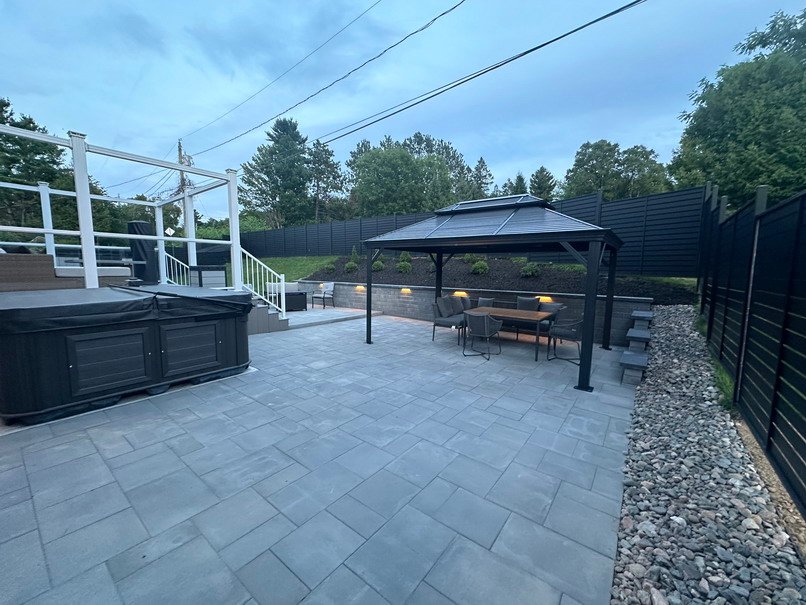
Freeze-thaw cycles define winter in New Brunswick. Water enters cracks and pores in patio surfaces. When temperatures drop below zero, that water freezes and expands by roughly 9%. The expansion creates internal pressure.
When it thaws, the material contracts. This happens dozens of times each winter. Over time, the repeated expansion and contraction breaks down the structural integrity of outdoor surfaces.
Rigid materials crack. Poured concrete is a single, solid slab. It has no flexibility. When the ground beneath it shifts due to frost heave, the concrete can’t move with it.
Stress concentrates at weak points, and cracks form. Even with control joints (the lines cut into concrete to guide cracking), unpredictable fractures still appear.
Flexible materials shift. Pavers are individual units laid over a compacted base of sand and aggregate. They’re not locked together like a slab. When the ground moves, each paver can shift slightly without breaking.
The joints between pavers absorb movement. If one section heaves, it can be lifted, relevelled, and reinstalled without replacing the entire surface.
Moisture absorption matters. Concrete is porous. It absorbs water. In freeze-thaw climates, that absorbed moisture freezes inside the material, causing surface scaling and spalling (when the top layer flakes off).
High-quality pavers are manufactured at 8,000+ PSI, making them denser and less porous than standard residential concrete (2,500–4,000 PSI). They resist moisture infiltration better.
Drainage is critical. Both materials need proper drainage. Water that pools on the surface or beneath it accelerates freeze-thaw damage. Pavers have joints that allow some water to drain between units.
Concrete relies entirely on surface slope to shed water. If the slope is inadequate or the slab settles unevenly, water pools and freezes.
Performance Factor | Poured Concrete | Interlocking Pavers |
|---|---|---|
Structural Flexibility | Rigid (cracks under ground movement) | Flexible (individual units shift independently) |
Strength (PSI) | 2,500–4,000 PSI | 8,000+ PSI |
Moisture Resistance | Porous (absorbs water) | Dense (resists absorption) |
Repair Complexity | Difficult (patches are visible and temporary) | Easy (replace individual units) |
Freeze-Thaw Resilience | Low (prone to cracking and spalling) | High (accommodates seasonal movement) |
Base preparation determines lifespan. Both concrete and pavers require a properly compacted base. In Fredericton’s clay-heavy soils, a 6–10 inch layer of Granular A (crushed limestone) is standard. This base drains water away from the surface and provides a stable foundation.
Without it, both materials will fail prematurely. The material you choose matters. But how it’s installed matters more.
Poured concrete is a single slab. It’s strong when the ground beneath it stays stable. But in freeze-thaw climates, the ground doesn’t stay stable.
Frost heave pushes sections upward. Settling creates voids underneath. Because concrete can’t flex, it cracks.
Control joints are planned cracks. Contractors cut lines into fresh concrete to guide where cracks will form. The goal is to keep fractures straight and hidden. But concrete doesn’t always cooperate.
Hairline cracks appear in unpredictable places. Once a crack forms, water enters, freezes, and widens it. Over time, small cracks become structural problems.
Pavers move without breaking. Each paver is a separate unit. They’re laid on a bed of compacted sand over a Granular A base. Polymeric sand fills the joints between pavers.
When the ground shifts, the pavers shift with it. They don’t crack because they’re not bonded together. If one section heaves, you lift the affected pavers, add or remove base material, and reset them. The repair is invisible.
Load-bearing capacity differs. Standard residential concrete is poured at 2,500–4,000 PSI. That’s strong enough for foot traffic and patio furniture. But pavers are manufactured at 8,000+ PSI or higher.
They’re denser and harder. If you’re planning to install a hot tub, outdoor kitchen, or heavy pergola, pavers handle the load better without cracking.
Concrete repairs are visible. When concrete cracks, you have three options: ignore it, patch it, or replace the entire slab. Patching involves filling the crack with a polymer-modified compound.
The patch is structurally temporary and visually obvious. The new material never matches the weathered original. Replacing the slab is expensive and disruptive.
Paver repairs are seamless. If a paver cracks (rare, but possible), you remove it and drop in a new one. If a section sinks, you lift the pavers, adjust the base, and reinstall them.
The repair blends in completely. For commercial properties or long-term homeowners, this repairability is a significant advantage.
Sealing extends lifespan for both materials. Concrete should be sealed every 2–3 years to prevent moisture infiltration and salt damage. Pavers also benefit from sealing, which protects against stains and enhances colour.
But even without sealing, pavers resist freeze-thaw damage better than concrete because of their density and jointing system.
Real-world longevity expectations:
Poured concrete in Atlantic Canada: 10–15 years before significant cracking occurs (with proper sealing and maintenance).
Interlocking pavers in Atlantic Canada: 25–30 years or more with minimal maintenance (assuming proper base preparation and polymeric sand).
Pavers cost more upfront. But they last longer, repair easier, and handle freeze-thaw cycles better than poured concrete. For properties in Fredericton and surrounding areas, that difference matters.
Poured concrete is the most affordable option upfront. The material is fluid, so it’s placed quickly. Labour costs are lower. For a basic broom-finish patio, it’s the budget-friendly choice.
Upfront installation costs (approximate):
Basic poured concrete: Lowest cost per square foot.
Stamped or coloured concrete: Mid-range (20–30% more than basic concrete).
Interlocking pavers: Highest initial cost (due to manual labour and material expense).
But initial cost isn’t the full story.
Maintenance requirements:
Concrete: Requires sealing every 2–3 years. Cracks need patching. If the slab settles or heaves, repairs are expensive and often ineffective. Stains (oil, rust, grease) are difficult to remove because concrete is porous.
Pavers: Benefit from sealing to protect against stains and enhance colour. Polymeric sand in the joints should be inspected and topped up every few years. If a paver shifts or cracks, it’s replaced individually without disturbing the rest of the surface.
Lifecycle costs:
Concrete: Patching cracks is temporary. If the slab develops widespread cracking or significant settling, the only real solution is full replacement. That means tearing out the old slab and starting over. Total replacement can cost as much as or more than the original installation.
Pavers: Repairs are localized. You lift the affected pavers, adjust the base, and reinstall them. The cost is minimal compared to replacing an entire concrete slab. Over 20–30 years, pavers typically have lower total ownership costs despite the higher upfront price.
Hidden costs to anticipate:
Drainage failures: If water pools against your foundation due to poor patio grading, you may face basement waterproofing costs (starting at $5,000+) or foundation repairs (exceeding $15,000).
Emergency repairs: A cracked, uneven patio is a tripping hazard. Liability concerns and safety issues can force expensive emergency fixes.
Property value impact: A well-maintained paver patio is viewed as a premium feature by appraisers and buyers. A cracked concrete patio becomes a negotiation point that reduces your home’s sale price.
Return on Investment (ROI):
Pavers are perceived as a higher-end upgrade in the real estate market. They signal quality and durability. A properly installed paver patio can return a significant portion of its cost at resale. A cracked concrete patio, on the other hand, can become a liability that reduces your home’s appeal.
Cost summary:
If your primary goal is the lowest immediate investment, poured concrete wins.
If you’re planning to stay in your home long-term or want to maximize resale value, pavers offer better lifecycle value despite the higher upfront cost.
For Fredericton homeowners dealing with freeze-thaw cycles, clay soils, and harsh winters, investing in pavers often pays off over time.
Choosing between concrete and pavers is only half the decision. How it’s installed determines whether it lasts 10 years or 30.
In Fredericton’s freeze-thaw climate, proper base preparation isn’t optional. Clay soils retain water and shift dramatically with ground freeze and thaw. Without a deep, well-compacted Granular A base, even the best materials will fail.
Drainage design is equally critical. Water that pools beneath or on top of your patio accelerates damage.
Atlantic Hardscape and Concrete has over 15 years of experience working with New Brunswick’s challenging soil conditions and extreme weather patterns. We install both poured concrete patios and interlocking paver systems using climate-specific techniques that account for frost heave, drainage, and long-term durability.
Our process includes:
6–10 inch compacted Granular A bases tailored to soil type and load requirements.
Polymeric sand in paver joints to resist erosion, weeds, and frost displacement.
Proper drainage integration with French drains, channel drains, and surface grading.
Pre-winter sealing for concrete surfaces to protect against moisture infiltration and salt damage.
We’ll assess your property’s specific conditions and recommend the material and installation method that makes sense for your budget and timeline.
For a consultation or to discuss your project, visit atlantichardscape.ca or contact us directly. We serve Fredericton, Oromocto, New Maryland, Hanwell, and surrounding communities.
Yes. Pavers can be installed over an existing concrete slab using the overlay method. The concrete must be structurally sound (no major cracking or heaving).
Weep holes are drilled through the slab to allow moisture to escape. A geotextile fabric layer is placed over the concrete, followed by bedding sand and pavers. Mortared border pavers or edge restraints are installed to prevent the paver field from spreading. This method extends the life of an old concrete patio without the cost of removal.
A properly installed and maintained concrete patio in Atlantic Canada typically lasts 10–15 years before significant cracking occurs. Lifespan depends on sealing frequency (every 2–3 years), drainage quality, and exposure to freeze-thaw cycles.
Unsealed concrete or poorly drained slabs can fail much sooner. Pavers, by contrast, often last 25–30 years or more with minimal maintenance.
Polymeric sand is a mixture of fine sand and polymer additives. It’s swept into the joints between pavers and activated with water. Once activated, it hardens to a plastic-like consistency, locking pavers in place and resisting erosion, weed growth, and ant infestations.
It’s a critical component of modern paver installations in freeze-thaw climates because it prevents joint material from washing out during spring thaws.
Not significantly. Both materials benefit from sealing every 2–3 years. Pavers require occasional joint sand replenishment if polymeric sand erodes over time.
Concrete requires crack patching and surface repairs as it ages. The key difference is that paver repairs are localized and invisible, while concrete repairs are often visible and temporary. Over the long term, pavers typically require less costly maintenance.
Pavers offer better slip resistance in icy conditions. The joints between pavers provide natural traction, and many paver textures are designed specifically to be slip-resistant.
Sealed or stamped concrete can become extremely slippery when wet or frozen. For safety near pools, walkways, or high-traffic areas, textured pavers are the better choice.
GET STARTED
Your dream space is within reach as we work together from detailed 3-D designs to the final custom build. Our process is both professional and exciting, and we look forward to taking this journey with you.
Contact
34 Jackstraw Court, Fredericton, NB, Canada, New Brunswick
